
DOWNLOAD NOW:
Today I am writing about heating and cooling options for your at-home wedding. When planning any outdoor wedding, you simply have to consider the weather. If you live somewhere seasonal, there’s no escaping that it will be hot in August and cold in January. So, short of changing your wedding date, how can you deal with less than ideal temperatures?
Cooling Your Wedding
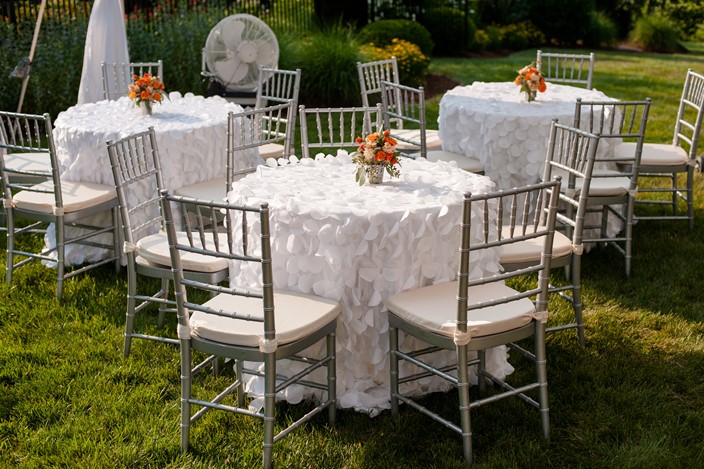
In the warmer months most people use fans – either freestanding or attached to tent poles –to help circulate air and keep guests cool. Fans also help keep bugs away. You need to talk to your tent professional about how many fans are appropriate for the size of your tents. Additionally, you can also get misting fans, which push a fine mist into the air and feel refreshing on a hot day. You can see a misting fan in the background of the below photo.
Some folks air-condition their tents. This is very expensive, and requires a tent with closed sidewalls in order to keep in the cool air contained. If you are setting up tents to function as temporary buildings, AC might work for you. But if you want your tents to be open because the surrounding landscape is an integral part of your wedding day, then you will likely stick to fans.
Fans draw a lot of power, so make sure the generator provider knows if fans are in your tented wedding plans. Fans are also noisy, and I often turn them off during speeches and toasts.
There are smaller steps you can take to keep your guests cool. Parasols, hand fans and ample access to ice cold water are just a few!
Heating Your Wedding
There are two kinds of heaters you can rent for your tented wedding: forced air and umbrella. Forced air heaters are generally used for tents. Umbrella heaters are not recommended for use inside a tent or similar structure.
Forced air heaters are large rectangular machines with a tube and a vent where the heat comes out. If space inside your tent is limited, you can place the forced air heaters outside of the tent, with the tube and vent running under a sidewall into the tent. If they are outside the tent, they will have to work harder to produce the warm air. This uses more fuel, which in turn may raise your fuel costs, depending on your contract with the purveyor. In order for the heaters to make a noticeable impact on your comfort, the tent must be sealed with the sidewalls, just as with air conditioning. Be aware that if there are guests seated by the forced air input, they will complain about being too hot.
Umbrella heaters, which are column-shaped, don’t take up much space. Their range is about six feet, and they are generally used around the perimeter of a ceremony space or scattered throughout a cocktail reception area. Make sure you have extra fuel (usually diesel or propane) on hand in case one of the heaters runs out before the event is over.
Those are the basics for heating and cooling options for your at-home wedding. I have also written more extensively about poor weather scenarios.
Photo made by Michelle Lindsay.
Check out my foundational home wedding blog posts about: backyard wedding tents, wedding tent flooring, professional lighting for your backyard wedding, restrooms for your backyard wedding, utilities for your backyard wedding, and making a smart transportation plan for your backyard wedding.
