
DOWNLOAD NOW:
As an expert wedding planner, I want to briefly walk you through the basics of tents available for backyard wedding rentals. Becoming familiar with this information will help you communicate with the wedding tent supplier and better understand the proposals and contracts you receive. There are five basic types of tents: pole, Sperry, frame, Navitrac and marquee.
Pole tents have the classic “circus” look with the high peaks of the (usually) white vinyl top. This backyard wedding tent is held in place by guylines that are staked into the ground around the perimeter, while tall center poles create the high peaks. A pole tent needs about eight feet of clearance around the perimeter to accommodate the length of the guylines. If you are planning on setting up a pole tent in your backyard near a landscaped or hardscaped area, or if the property has underground power, sewer or irrigation lines, ground staking may become a concern. A pole tent does not allow for a completely open floor plan; you will have to design your wedding floor plan around the center poles that hold up the tent’s top. Typical pole tents use metal side and center poles that are not aesthetically pleasing, so most people will cover them with fabric to match the tent top. These covers can be rented from the tent company at an additional cost.
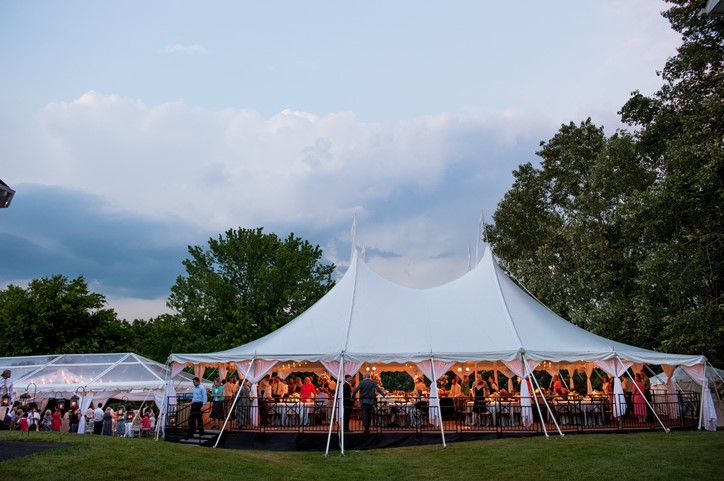
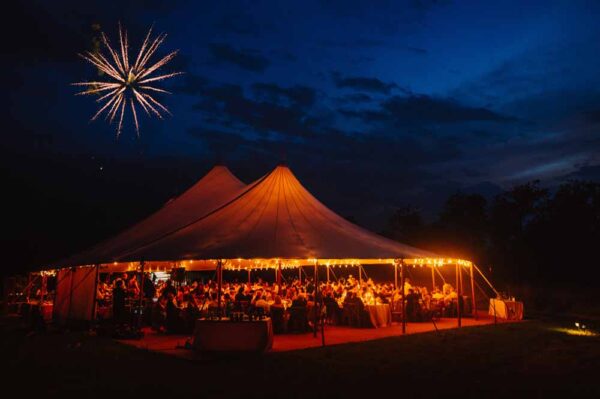
Sperry tents are the luxury version of a white vinyl pole tent. Sperry tent tops are made from a beautiful sailcloth that lets light pass through and makes for beautiful photographs at your backyard wedding. They are set up with handsomely finished wooden center and side poles instead of the metal poles that come with a standard pole tent, so they do not require fabric pole covers. Just like standard pole tents, they require guylines, ground staking, an extended perimeter, and they do not offer a completely open interior floor plan.
Above: Michelle Lindsay Photography. Below: Ken Pak Photography.
Frame tents are another popular option for backyard weddings. Their ceiling structures are created with a metal frame and crossbars to look more like the shape of a roof of a house. Frame tents set up for backyard weddings may be held down with weights (usually rain barrels) or by guylines. They do not need as many guylines as a pole tent, nor do they require as wide of a perimeter for staking. The floor plan inside a frame tent is completely open because there are no center poles to work around. The metal ceiling frame, however, is not attractive, so you might decide to rent fabric ceiling drapes to cover it. Frame tents generally come with either a white or clear top. If you opt for the clear top, you likely won’t want to rent fabric ceiling drapes.
Below: MK McKenna Photography
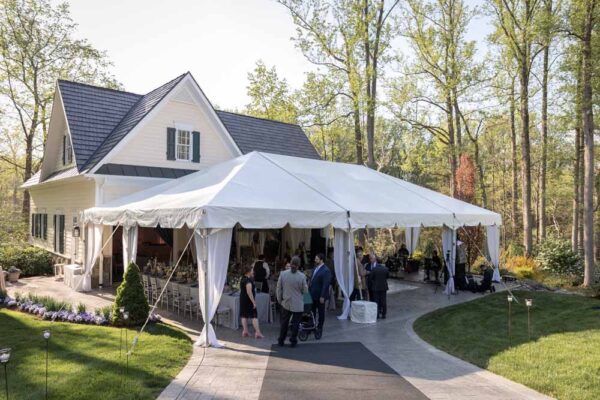
A variation of a frame tent for a backyard wedding is called a Navitrac tent. It has a taller and sturdier frame than the traditional frame tent, and is recommended for use when you might be facing worrisome weather. Since these and frame tents do not require ground staking, they can be placed directly against the side of a building and be held down with weights. A gutter can be installed between a tent and a building to prevent rain dripping between the two structures.
Marquee tents aren’t actually tents for gathering under. They are frame-tent-style, typically only 10 feet wide, and are set up to serve as hallways or corridors connecting different tents and buildings at your backyard wedding. Usually, you would use these in poor weather to link different areas, for example, to provide a covered path from the reception tents to the restrooms or the caterer’s prep area.
Let’s talk about tent side walls for a moment. I want you to know that if you need to put side walls on reserve for your wedding day rain plan, you have some options. There are solid white side walls available, in case there is something unattractive outside your tent and you want to block the view. There are also side walls that have clear “windows” on them that give your guests a limited view outside. And there are completely clear side walls that will protect your guests from the elements while still maintaining some of the open tent feel that you are probably hoping for. If you install sidewalls, the interior of your tent will get warm. This is good in the fall or winter, but bad for spring or summer backyard weddings. But you can rent AC units, in addition to forced air heaters, to help control the temperature in your backyard wedding tent.
